

A cheese company is left with a lot of whey after cheese production and doesn’t know what to do with such large quantities of this valuable by-product. Another company generates a lot of excess sawdust during the production of firewood. A third company has large amounts of second-grade apples left unused. All three companies decided to try a hackathon when they wanted to find ideas for utilizing these by-products.
A hackathon is a competition in which teams of companies, students, research organizations, or innovators develop solutions to a challenge presented in the competition. These innovation competitions, known as hackathons, originated decades ago in the computer industry but are now even being used in the development of the bio-circular economy.
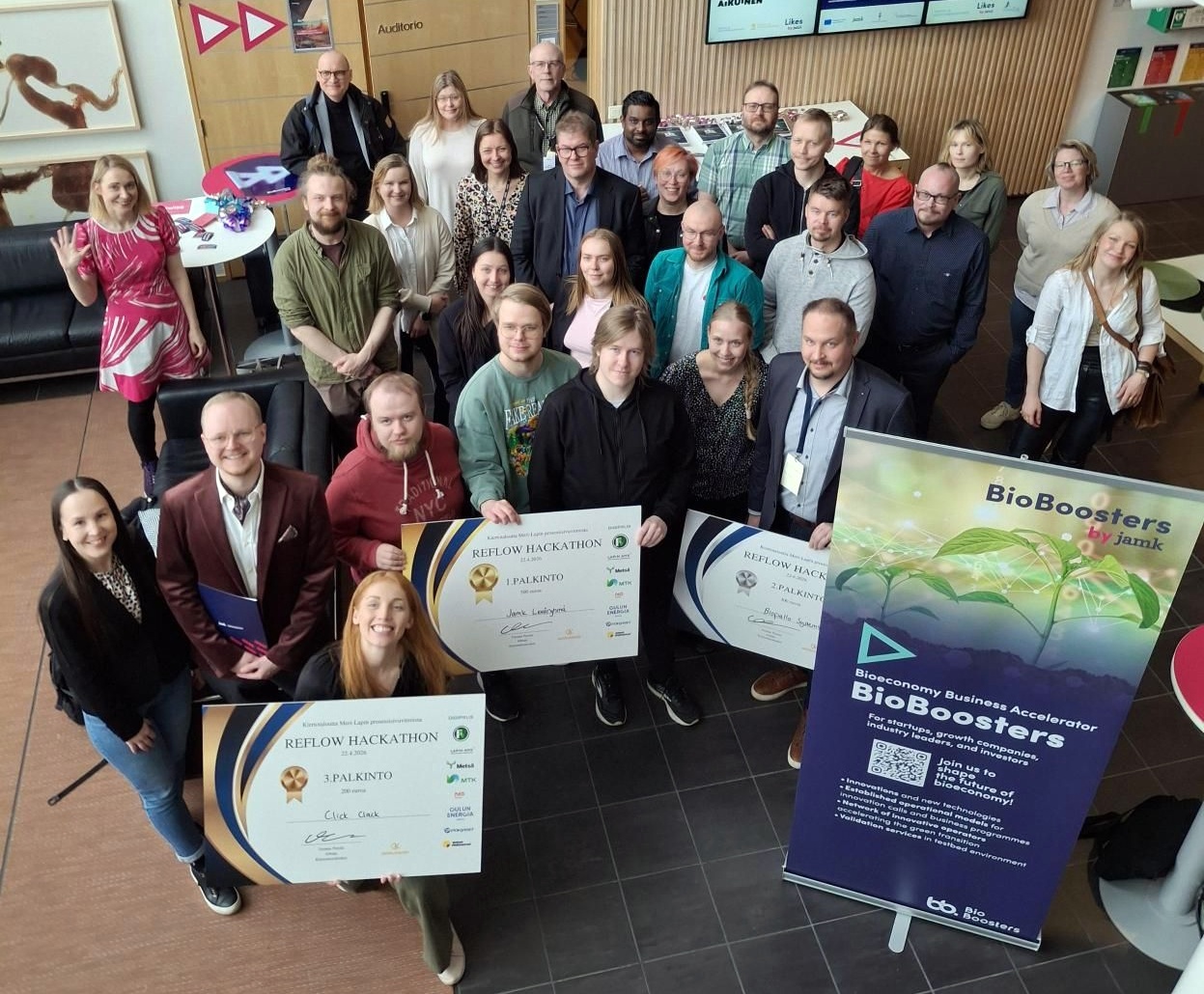
“We’ve been developing a hackathon model suitable for the bio-circular economy for seven years now. Now it works, and we have organized bio-circular economy hackathons for over 40 companies or organizations,” says Eija Iso-Ahola, Business Manager at Jamk’s Bioeconomy Institute.
The hackathon takes 2–3 months
In Jamk’s model, the hackathon typically lasts about 10 weeks in total. First, the problem is defined in collaboration with the client company. After this, Jamk publishes an open call for applications, to which anyone can apply with their own idea. The best teams from among those wishing to participate in the hackathon are selected to move on to the next stage and are invited to a kick-off webinar, where participants can present their ideas and get to know each other. After this, the teams work on their own solutions, with the help of experienced mentors in the field. In just under a month, the hackathon day arrives, where solutions are developed—and at the end of the day, a winner is selected. The winner usually gets to collaborate with the client, and sometimes even pilot funding is offered.
“Based on the feedback we’ve received, even the teams that didn’t win usually feel they’ve benefited from participating. Through the hackathon, teams have received feedback that helps their own development work and found new partners. Sometimes teams have even ended up founding new companies together,” says Iso-Ahola.
Hackathons accelerate product development
Larger companies benefit from hackathons in that their own product development can be significantly accelerated.
“When we’ve discussed this with client companies, they’ve often said that they would never have had the time to devote so much to product development that they could have developed their service this quickly.”
Iso-Ahola tells the story of a company that first tried to find a new use for its by-products on its own for a year and a half without success. Then the company decided to try a hackathon. In just eight weeks, the Jamk team identified new partners for the hackathon client, with whom the client then continued planning their collaboration.
“They then said that maybe they should have contacted us a little sooner,” Iso-Ahola says with a smile.
“Development work often gets pushed aside in favor of other tasks, and then the side projects end up being discarded, even though they actually have a lot of potential for use in other business operations.”
Read more about Jamk’s BioBoosters Hackathons.