



The factory premises in Nykarleby are teeming with life. The boxes are swarming with a huge number of larvae, each about a centimetre long. Robots look after them under computer-controlled conditions and feed them a set amount of food. The larvae devour everything they are given, as they are growing at a rapid pace. Within 14 days, the larvae are large enough to be used as high-quality animal feed. In the larvae, the plant matter has largely been converted into protein and fat.
“We realised early on that this is particularly well suited as food for pets,” explains Pontus Sundvik, one of the company’s owners.
He and the other founder, Mats Lindborg, have extensive experience in agriculture. Sundvik has produced feed for the fur industry, and Lindborg has reared pigs. They were looking for new opportunities and, at conferences, larvae were presented as a raw material for feed. Two years ago, they began building a factory on the outskirts of Nykarleby, and in the near future, robots will be working continuously with the larvae in the factory halls.
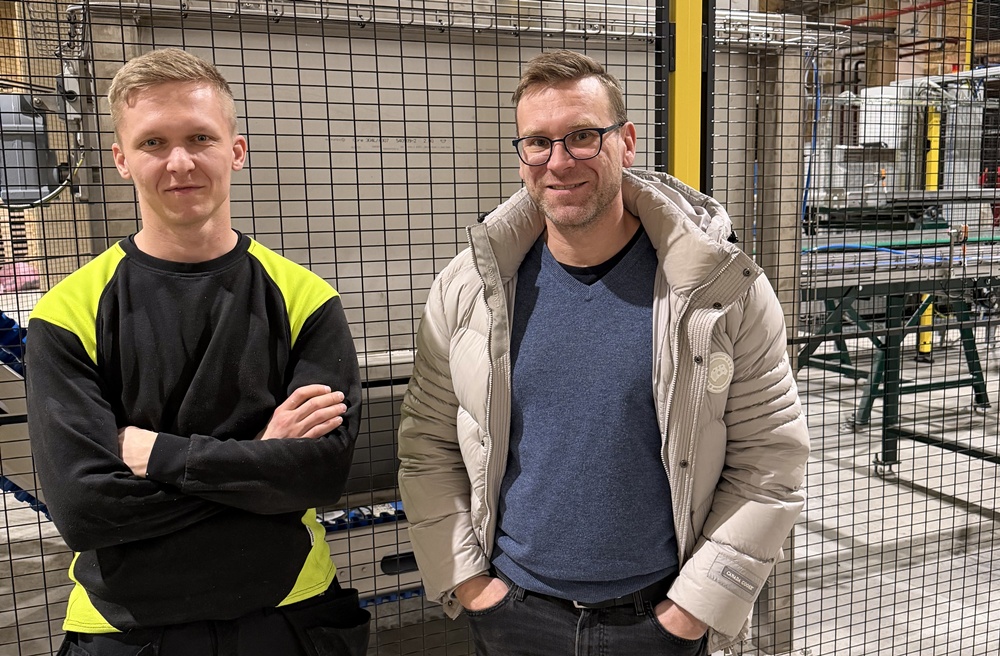
Jepro’s founders, Mats Lindborg (left) and Pontus Sundvik. Photo: Janne Smeds
The larvae are fed potatoes that are unsuitable for shops
The idea can be considered simple. The larvae are fed, for example, potatoes that are too small or not attractive enough for shops and restaurants, or potato peelings. Such potatoes grow in large quantities on potato farms, because although nature produces many different varieties of potato, it is, for example, only the tubers that are large enough and of a suitable shape that are suitable for restaurants and peeling machines. Potatoes are nutritious food even when they do not fit into peeling machines, yet for many potato growers, such second-grade potatoes are mostly a problem that they would prefer to simply get rid of somewhere. At present, second-grade potatoes can, for example, be used for potato flakes, but for large quantities, other uses are needed besides potato flakes, preferably ones where the grower can get a better price.
“You could feed the larvae many different kinds of food; ideally, they would surely prefer animal-based feed or slaughter by-products. By law, however, they are only allowed to eat plant-based feed,” explains Sundvik.
As for the potatoes, it is simply important that there are no rotten tubers and that the stones have been washed off the potatoes. Otherwise, the larvae thrive.
The larvae contain protein and high-quality fat
At the same time, the fact that the larvae grow quickly is utilised. Around the world, black soldier fly larvae in particular are farmed as feed. During their first week of life, they grow very rapidly. The robot then separates the larvae from the growing medium and cleans them. The larvae are subsequently dried, for example, in an oven or dryer, resulting in a feed with a long shelf life. The dried larvae are ground into flour. High-quality oil can also be pressed from the dried larvae. Both the meal and the oil are nutritious and environmentally friendly compared to, for example, soya-based protein-rich feed.
Sundvik points out that, for example, the feed meal they produce is rich in high-quality amino acids, fats and trace elements. Almost all the proteins are easily digestible, and the feed is also suitable for hypoallergenic diets. The feed is suitable not only for pets but also for fish, such as salmon and trout, as well as crayfish. The oils pressed from the larvae also have a high lauric acid content, and the oil’s antimicrobial properties promote gut health.
A by-product of animal feed production is also frass. This consists of the insects’ faeces, dead insects and uneaten food scraps, and is therefore well-suited as fertiliser.

The machine monitors the rearing of the larvae. Photo: Janne Smeds
Rearing larvae for feed is rapidly becoming more common
Industrial rearing of larvae for feed is relatively new worldwide. It only began on a large scale about a decade ago. However, it is rapidly becoming more common. When larval feed can be produced at the same price as soya, it easily replaces soya in many contexts thanks to its environmental friendliness. Production also offers new income opportunities for farmers, whose production has so far remained largely untapped.
Capacity at the facility has already increased rapidly.
“Once the factory is complete, we will be able to produce 20 tonnes of larvae per day at the facility we are building,” says Sundvik.
Jepros’ feed withstands transport and storage well. According to Sundvik, the finished feed is therefore largely sold abroad – there are large markets for Finnish larvae worldwide.
KristinaEco is organising a meeting at Restaurant Ström in Kristinestad on 8 April from 9.30 am to 12.00 pm, where potato growers from the region and representatives from Jepro will discuss the possibility of selling second-grade potatoes as feed for larvae. Please register in advance by emailing janne.smeds@krs.fi or by calling 0405883432.