


The forest industry is seeking new opportunities in the manufacture of bioeconomy products. These projects have been hampered by intensifying international competition, as Asian companies in particular have expanded their range of bioeconomy products on the global market. Nevertheless, the forest industry continues to explore new opportunities, as paper exports have fallen to a quarter of their peak levels of 20 years ago.
As recently as 2025, one of Finland’s three major forest industry companies, Metsä Group – a cooperative of Finnish forest owners – was planning to build a textile fibre mill. Metsä Group intended to invest 400 million euros in the mill.
This year, Metsä Group announced that it was abandoning the project. Recently, more factories than the market demands have been built in Asia to produce wood-based fibre for textile manufacturing. As a result, fibre prices have fallen too low. China, India and Thailand all produce significant quantities of dissolving pulp, which they process further into Lyocell fibre. Costs are also lower in Asia, so the price that is sufficient for Asian mills is not yet enough to make production in Finland profitable.
However, the difficulties in the textile fibre market are not deterring Metsä Group from seeking new business opportunities. It is planning a new factory that would specialise in the manufacture of containers made from cellulose. Metsä Group plans to establish the new factory in Äänekoski, where containers made from cellulose are already being produced in a small pilot plant.
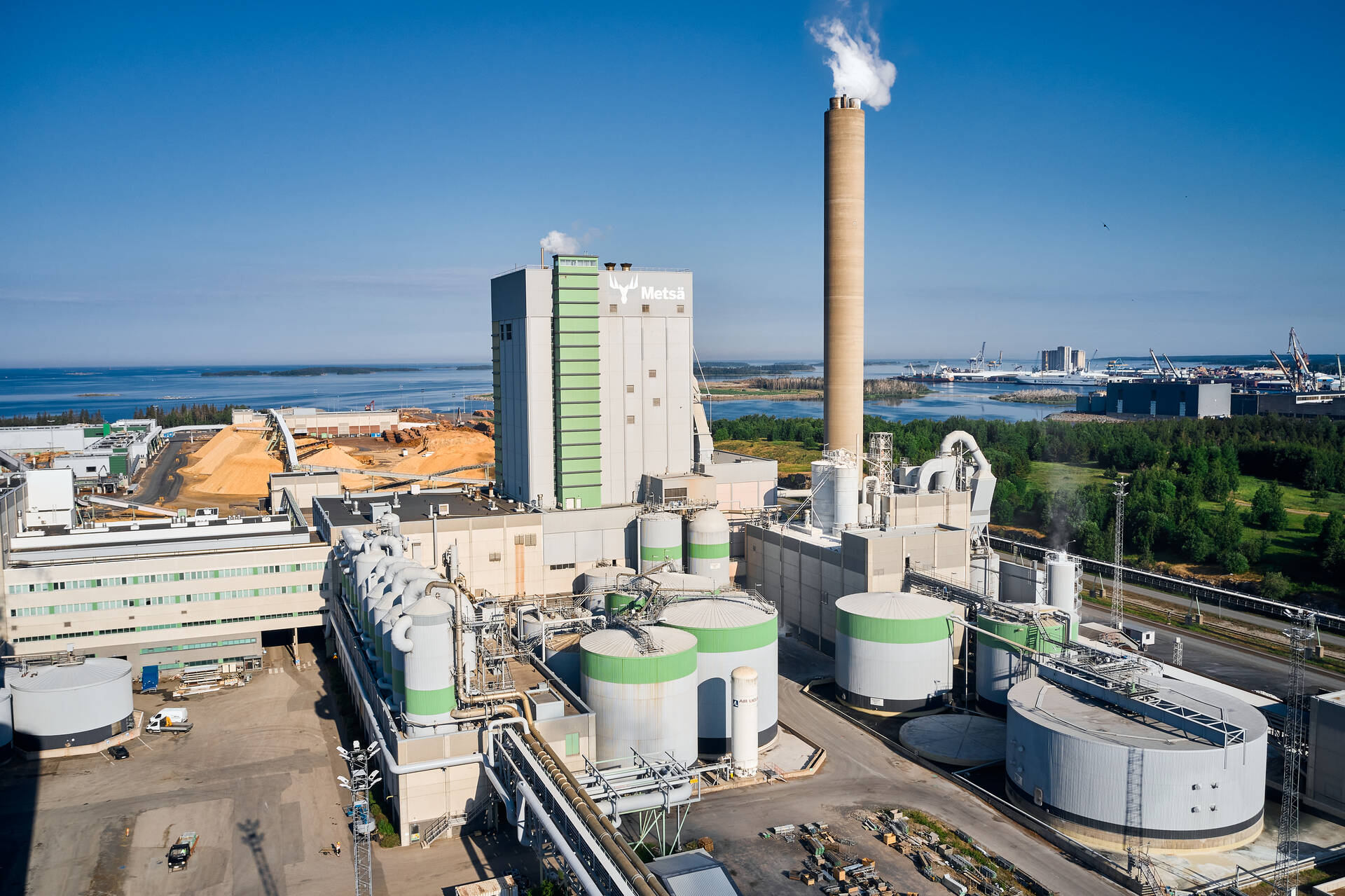
In connection with the Rauma pulp mill, Metsä Group is planning a new carbon dioxide capture plant, which could open up opportunities for a completely new type of business in the future.
Stora Enso ceased the production of dissolving pulp in Joensuu
Stora Enso, one of Finland’s three major forestry companies, was forced to cease production of dissolving pulp at its Uimaharju plant in Joensuu as early as 2022. Stora Enso had been producing dissolving pulp at this plant for Asian companies for the manufacture of viscose fabrics. Now, the price of dissolving pulp alone has also fallen to a level that is too low relative to Finnish price levels, as production of dissolving pulp in Asia has increased. The Uimaharju mill is still in operation, but the pulp it produces is now used, for example, to insulate electrical cables.
Stora Enso has also experimented with processing wood into carbon suitable for batteries. Battery production and demand are growing rapidly, but even now, five years on, no decision has been made to expand the pilot plant into a full-scale production facility.
Chemicals: a promising sector
At present, wood-based chemicals appear to be the most promising options. UPM, Finland’s third-largest forest industry company, has invested over one billion euros in a plant in Leuna, Germany, which manufactures chemicals for industrial use. The biochemicals produced at the Leuna plant replace, for example, chemicals made from oil and gas. The plant is still in the start-up phase.
UPM’s biorefinery in Lappeenranta has been in operation for 11 years and has become Finland’s most successful example of the forest industry’s expansion into new markets in the bio-based products sector. Pine oil is produced as a by-product of the pulp mill. The biorefinery turns this into fuel that can be blended with the standard fuel used in cars. Demand for this biofuel is driven by a mandatory blending requirement, which compels fuel retailers to blend a certain proportion of bio-based fuel into fuel made from mineral oil, even though biofuel is more expensive than fuel refined from mineral oil. The proposed reduction in the blending obligation, which is currently under discussion, is dampening companies’ enthusiasm for expanding biofuel production.